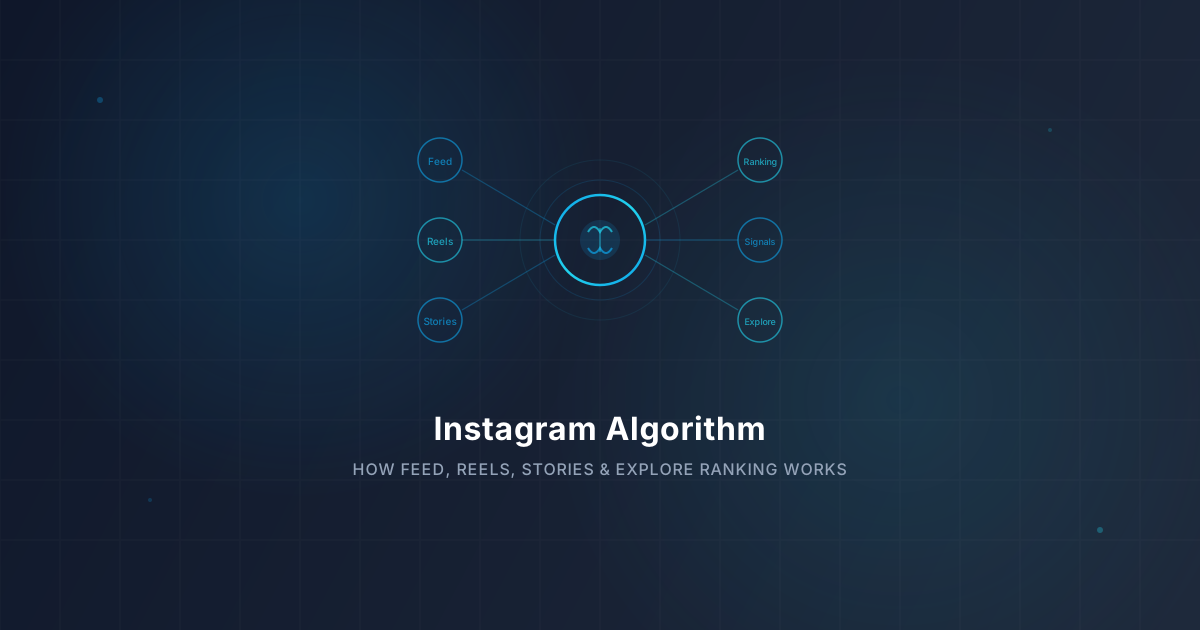
How the Instagram Algorithm Works in 2026 — Feed, Reels, Stories & Explore Explained
Understand how the Instagram algorithm ranks content in 2026. IGStoryPeek breaks down ranking factors for Feed, Reels, Stories, and Explore so you can grow.
How the Instagram Algorithm Works in 2026 — Feed, Reels, Stories & Explore Explained
Key Takeaways: There is no single Instagram algorithm — each surface (Feed, Reels, Stories, Explore) uses its own ranking system. Understanding these systems helps you create content that reaches more people. Use IGStoryPeek’s Activity Analyzer to study how top accounts optimize for each ranking system.
The phrase “the Instagram algorithm” gets thrown around constantly, but it’s misleading. Instagram doesn’t use one algorithm. It uses multiple ranking systems, each tailored to a specific part of the app. In 2026, these systems have become more sophisticated, but the core principles remain surprisingly transparent.
This guide breaks down how each ranking system works, what signals matter most, and what you can actually do about it.
The Fundamental Principle Behind All Instagram Ranking
Every ranking system on Instagram tries to answer the same question: what content will this specific user find most valuable right now?
Instagram measures “value” through behavioral signals — what people tap, watch, save, share, comment on, and linger over. The platform has been clear that it doesn’t suppress content for business reasons or to force advertising spend. Reach declines almost always trace back to content that doesn’t match audience expectations.
In 2026, Instagram has doubled down on personalization. Two users following identical accounts will see completely different feeds based on their individual behavior patterns.
How the Feed Algorithm Works in 2026
The Feed is where you see posts from accounts you follow, plus a small percentage of suggested content from accounts you don’t follow.
Primary Ranking Signals for Feed
Instagram’s Feed ranking weighs these factors in roughly this order of importance:
-
Relationship strength — how often you interact with the posting account. Likes, comments, DMs, profile visits, and Story views all contribute. If you regularly engage with an account, their posts appear higher in your Feed.
-
Interest prediction — Instagram predicts how likely you are to engage with a specific post based on your past behavior with similar content. If you always like food photography, new food posts rank higher for you.
-
Timeliness — newer posts rank higher than older ones, though Instagram no longer uses strict chronological order. Posts from the last few hours get a significant boost.
-
Content type preference — if you tend to engage more with carousels than single images, you’ll see more carousels. This signal has become stronger in 2026.
How to Work With the Feed Algorithm
Post consistently so the algorithm has fresh content to rank. Use formats your audience prefers — check your Insights to see which format types generate the most engagement. And focus heavily on building genuine relationships with your followers through replies, DMs, and Story interactions.
You can study how successful accounts in your niche structure their Feed content using IGStoryPeek’s Post Viewer. Analyzing what works for others gives you a concrete starting point.
How the Reels Algorithm Works in 2026
Reels operate on a fundamentally different ranking system than the Feed. Reels are designed for discovery, meaning most Reels viewers are people who don’t follow the creator.
Primary Ranking Signals for Reels
-
Watch time and completion rate — this is the dominant signal. A Reel that people watch to the end (or rewatch) vastly outperforms one that gets swiped past after two seconds. In 2026, Instagram weighs average watch percentage even more heavily than total views.
-
Engagement velocity — how quickly a Reel accumulates likes, comments, shares, and saves after posting. Fast early engagement signals to Instagram that the content is worth distributing more widely.
-
Audio and effect popularity — Reels using trending audio or effects get a temporary distribution boost. This has been a consistent pattern since Reels launched and remains true in 2026.
-
Creator history — accounts that consistently produce Reels with high engagement earn a “quality score” that gives their new content a slight initial boost in distribution.
How to Work With the Reels Algorithm
Hook viewers in the first second. Literally — the opening frame and first second determine whether someone watches or swipes. Keep Reels concise; a 15-second Reel with 90% completion rate will outperform a 90-second Reel with 20% completion rate.
Use our Instagram tools to find relevant tags that help Instagram categorize your Reels for the right audience. Proper categorization matters more for Reels than any other content type because the distribution pool is so large.
How the Stories Algorithm Works in 2026
Stories appear in the tray at the top of the app, and the order is entirely personalized based on the viewer’s relationship with each account.
Primary Ranking Signals for Stories
-
Viewing history — accounts whose Stories you watch consistently appear first. If you always watch a friend’s Stories, they stay at the front of your tray.
-
Interaction frequency — replies, poll votes, quiz answers, and emoji reactions all signal strong interest. Interactive Story elements directly boost ranking.
-
Closeness signals — Instagram uses the same relationship graph that powers Feed ranking. Accounts you message, tag, and engage with across multiple surfaces rank higher.
-
Recency — newer Stories get priority, but relationship strength can override this. A close friend’s 12-hour-old Story might still rank above an acquaintance’s 1-hour-old Story.
How to Work With the Stories Algorithm
Post Stories regularly — even 2-3 per day — to maintain your position in followers’ trays. Use interactive stickers (polls, questions, sliders) because they generate the engagement signals that boost ranking. Reply to every Story reply you receive, which strengthens the relationship signal in both directions.
To see how competitors and top creators structure their Stories, use IGStoryPeek’s Stories Viewer. You can watch their Stories anonymously and study cadence, content types, and interactive elements without affecting your own Instagram activity.
How the Explore Page Algorithm Works in 2026
Explore is Instagram’s discovery engine. Every piece of content on the Explore page comes from accounts you don’t follow, selected based on your demonstrated interests.
Primary Ranking Signals for Explore
-
Your interest clusters — Instagram groups content into topic clusters. Based on your engagement history, it identifies which clusters you’re interested in and serves content from those areas.
-
Post performance among similar audiences — if a post performs well among users who share your interest profile, it’s more likely to appear on your Explore page.
-
Content freshness — Explore favors recent content, though high-performing older posts can still surface.
-
Creator credibility — accounts with a history of policy compliance and consistent engagement earn better Explore placement. Accounts with recent guideline violations see reduced Explore distribution.
How to Work With the Explore Algorithm
Create highly focused content that clearly fits into a topic cluster. Vague, unfocused posts struggle on Explore because Instagram can’t confidently categorize them. Use relevant hashtags and descriptive captions to help the system understand what your content is about.
Signals That Hurt Your Reach in 2026
Understanding what lowers your ranking is just as important as knowing what boosts it.
- Engagement bait — “Like if you agree” or “Comment YES for a surprise” triggers suppression in 2026. Instagram’s detection has become very accurate.
- Recycled content — reposting the same content (especially Reels) with minor modifications gets flagged and deprioritized.
- Watermarks from other platforms — Reels with visible TikTok watermarks still receive reduced distribution.
- Guideline violations — even borderline content can trigger “shadow” reach reduction without a formal notice.
- Inauthentic engagement — bought likes, comments from engagement pods, and follow/unfollow tactics can all lead to reduced reach. Use IGStoryPeek’s Activity Analyzer to check whether any accounts you engage with heavily show signs of inauthenticity.
The Role of AI in Instagram’s 2026 Algorithm
Instagram now uses large language models and multimodal AI to understand content at a deeper level than ever before. The platform can analyze the actual subject matter of images and videos, read text in graphics, and understand the context of spoken words in Reels.
This means surface-level optimization tricks matter less. What matters more is whether your content genuinely delivers value to the people who see it. The algorithm is increasingly capable of distinguishing between content that looks engaging and content that actually is engaging.
Frequently Asked Questions
Does the Instagram algorithm penalize business accounts in 2026?
No. Instagram has stated repeatedly — and independent studies confirm — that business and creator accounts receive the same algorithmic treatment as personal accounts. If your business account sees lower reach, it’s a content or audience issue, not an account type issue.
How long does it take for the algorithm to rank a new post?
Instagram typically evaluates a post within the first 30-60 minutes by showing it to a small segment of your audience. If early engagement is strong, distribution expands. Most posts reach their peak distribution within 24-48 hours for Feed content and up to 7-14 days for Reels.
Can I reset the Instagram algorithm for my account?
There’s no reset button, but you can shift the algorithm’s behavior by consistently posting different content over 4-6 weeks. Instagram recalibrates its predictions based on recent audience behavior. Study what successful accounts do using tools like IGStoryPeek and adapt your approach accordingly.
Do hashtags still matter for the Instagram algorithm in 2026?
Hashtags serve primarily as a categorization signal in 2026. They help Instagram understand what your content is about and who might want to see it. They no longer function as a discovery channel the way they did in earlier years, but using relevant, specific hashtags still contributes to proper content classification.
Is posting time still important for the algorithm?
Yes, but less than it used to be. Posting when your audience is active gives you a better chance of strong early engagement, which influences broader distribution. However, a great piece of content posted at a suboptimal time will still outperform mediocre content posted at the perfect time. Focus on quality first, timing second.
Sources
- How Instagram’s Algorithm Works — Instagram Official Blog
- Instagram Ranking and Recommendations — Instagram for Creators
- Understanding Instagram’s Recommendation Guidelines — Meta Transparency Center
- Instagram Help Center — How Feed Works — Instagram Help Center
You might also like
- Instagram Reels vs Stories in 2026 — Which Format Wins for Reach and Engagement?
- Instagram Story Highlights — The Complete Guide to Creating & Viewing in 2026
- Instagram Hashtag Strategy — How to Maximize Your Reach in 2026
- How to Browse Instagram Stories Without an Account in 2026
- Instagram Rules: Complete Guide to Every Essential Rule 2026
Share this article
Alex Morgan
Content strategist at IGStoryPeek. Specializing in Instagram analytics, engagement optimization, and content strategy.
Try IGStoryPeek →Related Posts
Instagram Reels vs Stories in 2026 — Which Format Wins for Reach and Engagement?
Compare Instagram Reels vs Stories in 2026: reach, engagement, algorithm tips, and when to use each. Use IGStoryPeek to analyze performance and optimize your strategy.
Instagram Story Highlights — The Complete Guide to Creating & Viewing in 2026
Everything about Instagram Story Highlights in 2026. Learn how to create, organize, and design Highlights. Use IGStoryPeek to view anyone's Highlights easily.
Instagram Hashtag Strategy — How to Maximize Your Reach in 2026
Master Instagram hashtags in 2026 with proven strategies for reach and discovery. Use IGStoryPeek's Hashtag Generator to find the best tags for your niche.
How to Browse Instagram Stories Without an Account in 2026
Learn how to browse Instagram stories without logging in or creating an account. Discover the easiest methods to view Instagram stories for free in 2026 using IGStoryPeek. No login required.
Instagram Rules: Complete Guide to Every Essential Rule 2026
Learn all Instagram rules for 2026. Complete guide covering community guidelines, content rules, account policies, and how to stay safe on the platform.