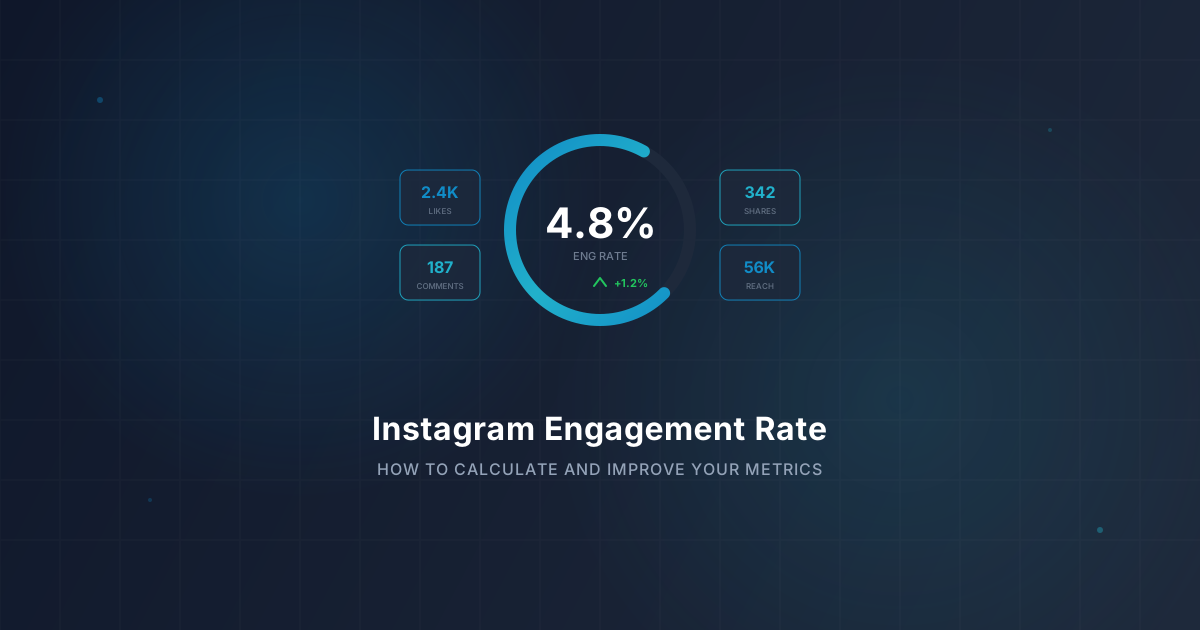
Instagram Engagement Rate — How to Calculate It & What's a Good Rate in 2026
Learn how to calculate your Instagram engagement rate in 2026 with exact formulas and niche benchmarks. Use IGStoryPeek's free tools to measure real performance.
Instagram Engagement Rate — How to Calculate It & What’s a Good Rate in 2026
Key Takeaways: Your engagement rate is the single most important metric for Instagram growth and brand deals in 2026. Use IGStoryPeek’s Activity Analyzer to instantly calculate any public account’s engagement rate without logging in — just enter a username and get a full performance breakdown.
Follower count used to be the number everyone chased. That era is over. In 2026, brands, agencies, and the Instagram algorithm itself care far more about engagement rate than raw follower numbers. A creator with 8,000 highly engaged followers will consistently outperform one with 200,000 passive ones — in reach, in brand deal value, and in long-term growth.
This guide covers the exact formulas you need, what counts as a good rate in your niche, and how to improve your numbers starting today.
What Is Instagram Engagement Rate?
Engagement rate measures how actively your audience interacts with your content relative to your audience size. It turns raw numbers (likes, comments, shares, saves) into a percentage that can be compared across accounts of any size.
A nano-influencer with 3,000 followers and a celebrity with 10 million followers can be compared side by side using engagement rate — and the nano-influencer often wins.
Why It Matters in 2026
- Algorithm ranking — Instagram’s 2026 algorithm uses engagement velocity (how quickly a post gets interactions) to decide whether to push it to Explore and Reels feeds.
- Brand partnerships — Most brands now require engagement rate data before signing any collaboration. Rates below a certain threshold disqualify creators regardless of follower count.
- Audience health — A declining engagement rate is an early warning sign that your content is losing relevance or that your follower base includes too many inactive or fake accounts. Tools like IGStoryPeek’s Activity Analyzer can help you identify these issues.
How to Calculate Instagram Engagement Rate
There are several formulas used across the industry. The right one depends on what you’re trying to measure.
Formula 1: Engagement Rate by Followers (ERF)
This is the most common formula and the one brands use most often.
ERF = (Total Engagements / Total Followers) x 100
Where Total Engagements = Likes + Comments + Saves + Shares on a single post.
For example, if a post gets 450 likes, 32 comments, 78 saves, and 15 shares on an account with 10,000 followers:
ERF = (575 / 10,000) x 100 = 5.75%
Formula 2: Engagement Rate by Reach (ERR)
This formula uses actual reach instead of followers, making it more accurate but requiring access to Instagram Insights (available only to the account owner).
ERR = (Total Engagements / Reach) x 100
Reach-based rates are typically higher than follower-based rates because not all followers see every post.
Formula 3: Average Engagement Rate
To get a reliable picture, calculate the rate across multiple posts:
Average ER = (Sum of ER for last 10-30 posts) / Number of posts
This smooths out outliers like viral posts or underperforming content. You can quickly assess any public account’s average performance using IGStoryPeek’s Activity Analyzer, which runs these calculations automatically.
What Is a Good Engagement Rate in 2026?
Benchmarks vary significantly by follower count and niche. Here are the 2026 industry averages based on follower-based engagement rate.
By Account Size
| Account Size | Average ER | Good ER | Excellent ER |
|---|---|---|---|
| Nano (1K-10K) | 4.0% | 5.5%+ | 8.0%+ |
| Micro (10K-50K) | 2.5% | 3.5%+ | 5.5%+ |
| Mid (50K-200K) | 1.8% | 2.5%+ | 4.0%+ |
| Macro (200K-1M) | 1.2% | 1.8%+ | 3.0%+ |
| Mega (1M+) | 0.8% | 1.2%+ | 2.0%+ |
Smaller accounts almost always have higher engagement rates. This is normal and expected — it reflects tighter community connections and more personal interactions.
By Niche (2026 Benchmarks)
- Fitness & Health — 3.2% average
- Food & Cooking — 2.8% average
- Travel — 2.4% average
- Fashion — 1.9% average
- Tech & Gadgets — 1.7% average
- Finance & Business — 1.4% average
- Entertainment & Memes — 3.6% average
If your rate is above the average for your niche and account size, you are doing well. If it is significantly below, it is time to investigate why.
Why Your Engagement Rate Might Be Low
A below-average engagement rate is not always about content quality. Several structural issues can drag your numbers down.
Fake or Inactive Followers
Purchased followers, follow-for-follow campaigns, and old inactive accounts inflate your denominator without adding any engagement. Use an activity analyzer to check your audience quality.
Posting at the Wrong Times
If your audience is mostly in Europe but you post at 3 AM CET, most of your followers will never see the content during its critical first hour. Check your Instagram Insights for when your audience is most active.
Content-Audience Mismatch
If you grew your audience posting travel content and then pivoted to finance tips, your existing followers may not engage with the new direction. The audience you have and the content you create need to align.
Ignoring Stories and Reels
In 2026, Instagram distributes Reels to non-followers far more aggressively than feed posts. If you are only posting static images, you are missing the format that drives the most discovery. You can analyze how other successful accounts use Stories with IGStoryPeek’s Stories Viewer to get inspiration.
How to Improve Your Engagement Rate
Write Better Captions
Captions that ask questions, share personal opinions, or invite debate generate significantly more comments. A post that says “Beautiful sunset” gets scrolled past. A post that says “Unpopular opinion: sunsets are better from cities than beaches. Agree or disagree?” starts conversations.
Use Hashtags Strategically
The right hashtags put your content in front of people who care about your topic but don’t follow you yet. Use our Instagram tools to find relevant, properly sized hashtags for your niche rather than relying on the same overused tags.
Engage With Your Community
Reply to every comment within the first hour. Visit your commenters’ profiles and leave genuine comments on their posts. This builds reciprocal relationships that compound over time.
Analyze What Works
Look at your top-performing posts from the last 90 days. Identify patterns in format, topic, posting time, and caption style. Double down on what already resonates. Tools at IGStoryPeek can help you research competitors and see what drives engagement in your niche.
Post Consistently
The algorithm rewards accounts that post regularly. Find a sustainable cadence — three to five times per week is the sweet spot for most creators in 2026 — and stick to it.
Engagement Rate for Brand Deals — What Brands Expect
If you are seeking paid collaborations, understanding what brands look for will help you position yourself correctly.
Most brands in 2026 set a minimum engagement rate threshold:
- Nano and Micro creators — brands typically expect 3.5% or higher
- Mid-tier creators — 2.0% or higher is standard
- Macro creators — 1.5% or higher, with emphasis on reach volume
Beyond the rate itself, brands examine the quality of engagement. An account with 2% engagement but thoughtful, multi-sentence comments is more valuable than one with 4% engagement made up entirely of emoji replies. You can use IGStoryPeek’s Post Viewer to examine the engagement patterns on any public account.
Frequently Asked Questions
How often should I check my Instagram engagement rate?
Track it weekly using a rolling average of your last 10 posts. This gives you a stable trendline without overreacting to individual post performance. Monthly reviews are sufficient for strategic decisions about content direction.
Does Instagram show engagement rate in its native analytics?
No. Instagram Insights shows individual metrics like reach, impressions, likes, comments, saves, and shares, but it does not calculate an engagement rate percentage for you. You need to run the calculation yourself or use a third-party tool like IGStoryPeek to do it automatically.
Do Instagram Reels have a different engagement rate than feed posts?
Yes. Reels typically show higher engagement rates because Instagram distributes them to non-followers through the Reels tab and Explore page. This increases both the numerator (more interactions from new viewers) and can skew the rate if you use reach-based calculations. Many creators separate their Reels engagement rate from their feed post engagement rate for more accurate analysis.
Can buying followers actually hurt my engagement rate?
Absolutely. Purchased followers are almost always bots or inactive accounts that will never engage with your content. They increase your follower count (the denominator) while adding zero engagement (the numerator), directly lowering your engagement rate. This makes your account less attractive to brands and can reduce algorithmic reach.
What is the single fastest way to improve my engagement rate?
Reply to every comment on your posts within 60 minutes of posting. This does two things: it doubles the comment count (your reply counts as a comment), and it signals to the algorithm that the post is generating active conversation. Combined with asking a genuine question in your caption, this one habit can increase engagement rate by 30-50% within a few weeks.
Sources
- Instagram Insights and Analytics — Instagram Help Center
- Professional Dashboard for Creators — Instagram for Creators
- Instagram for Business — Measuring Performance — Instagram Business Tools
You might also like
- Instagram Activity Analyzer — Uncover Posting Patterns & Peak Engagement Times in 2026
- Instagram Competitor Analysis — How to Research & Benchmark Rivals in 2026
- Instagram Follower Analyzer — How to Track Growth & Spot Fake Followers in 2026
- Instagram Reels vs Stories in 2026 — Which Format Wins for Reach and Engagement?
- Instagram Content Calendar — Best Posting Schedule and Times for 2026
Share this article
Alex Morgan
Content strategist at IGStoryPeek. Specializing in Instagram analytics, engagement optimization, and content strategy.
Try IGStoryPeek →Related Posts
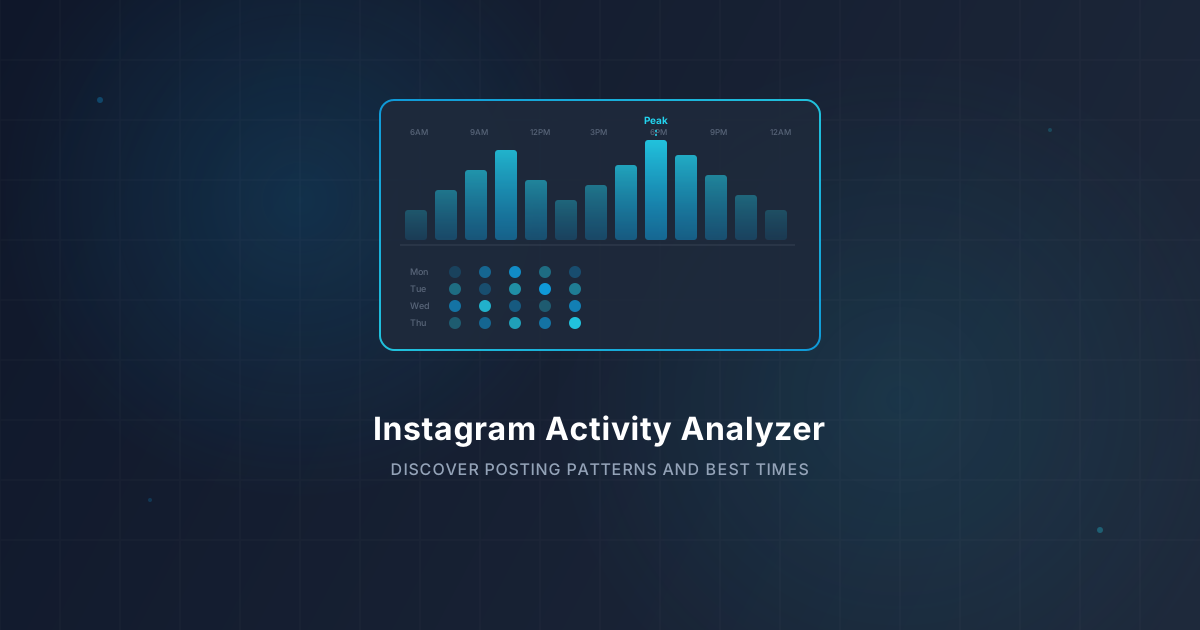
Instagram Activity Analyzer — Uncover Posting Patterns & Peak Engagement Times in 2026
Discover how to analyze Instagram posting patterns, find peak engagement times, and optimize your content strategy. Use IGStoryPeek's free activity analyzer for instant insights.
Instagram Competitor Analysis — How to Research & Benchmark Rivals in 2026
Master Instagram competitor analysis in 2026 with IGStoryPeek. Learn which metrics to compare, how to benchmark content strategies, and gain actionable insights.
Instagram Follower Analyzer — How to Track Growth & Spot Fake Followers in 2026
Learn how to analyze Instagram followers, track growth trends, and detect fake or bot accounts. Use IGStoryPeek's free follower analyzer to get instant audience insights without logging in.
Instagram Reels vs Stories in 2026 — Which Format Wins for Reach and Engagement?
Compare Instagram Reels vs Stories in 2026: reach, engagement, algorithm tips, and when to use each. Use IGStoryPeek to analyze performance and optimize your strategy.
Instagram Content Calendar — Best Posting Schedule and Times for 2026
Build a winning Instagram content calendar for 2026. Discover the best times to post, ideal frequency, and scheduling tips. Analyze top accounts with IGStoryPeek.